Building codes aren’t bureaucracy. They’re the technical foundation that determines how your commercial building is designed, what materials are used, and whether your project gets approved. In Canada, the National Building Code (NBC) sets the baseline, but provinces adapt it to their regional conditions. Understanding this hierarchy prevents costly redesigns and timeline delays.
This guide explains how NBC and provincial codes shape structural decisions, affect your project timeline, and influence approval outcomes across Canada.
What Are Building Codes, and How Do They Actually Affect Your Structural Design?
Building codes are minimum technical standards that legally govern how buildings must be designed and constructed. In Canada’s hierarchy, the National Building Code serves as the model that all provinces adopt and then modify.
Provinces don’t write codes from scratch, they take the NBC baseline and add amendments reflecting their climate, seismic activity, and regional construction practices.
The reality: National code tells you HOW to design. Provincial code tells you WHAT you must actually design for your specific location.
Why This Hierarchy Matters to Your Project
The key insight is that design based solely on the NBC is incomplete if your province has adopted amendments. Building officials focus on provincial requirements, not national baseline. When a structural engineer overlooks provincial variations, permits get rejected, requiring expensive redesign and significant timeline delays.
This is why many projects fail in permit review, not because they’re structurally impossible, but because provincial requirements weren’t understood or documented properly from the start.
What Does the National Building Code Require for Structural Design?
The NBC (current edition is 2020, updated every five years) sets minimum technical requirements for new construction and renovations. The code covers four critical structural areas: how to calculate building loads, what materials perform safely, how long structures must resist fire, and accessibility standards.
The NBC provides regional maps for environmental loads, material density tables for dead load calculations, and specific live load values for different building types. Every structural engineer in Toronto references these same baseline requirements.
Understanding Load Requirements Across Canada
Load calculations form the foundation of structural design. Dead loads are the building’s weight concrete, steel, finishes, mechanical systems. These are calculated precisely from architectural drawings.
Live loads are temporary people, equipment, stored materials and vary dramatically by building use. An office needs 2.4 kPa of live load capacity. A warehouse storing goods stacked high requires 4.8 to 9.6 kPa.
Environmental loads change by region. Snow load on a Vancouver coast is 0.9 kPa. In Northern Alberta, it reaches 3.5 kPa or more. Wind loads vary by building height and exposure. The NBC provides maps showing regional variations, but provinces often modify these values based on local experience and climate data.
Fire-resistance ratings are non-negotiable. An office building 10 to 25 meters tall needs a minimum 2-hour fire rating. A 25 to 50-meter office needs 3 to 4 hours. These ratings determine whether you use concrete (naturally fire-resistant), steel (requires protective coatings), or mass timber (calculated through char rate).
How Do Provincial Building Codes Change the Structural Requirements?
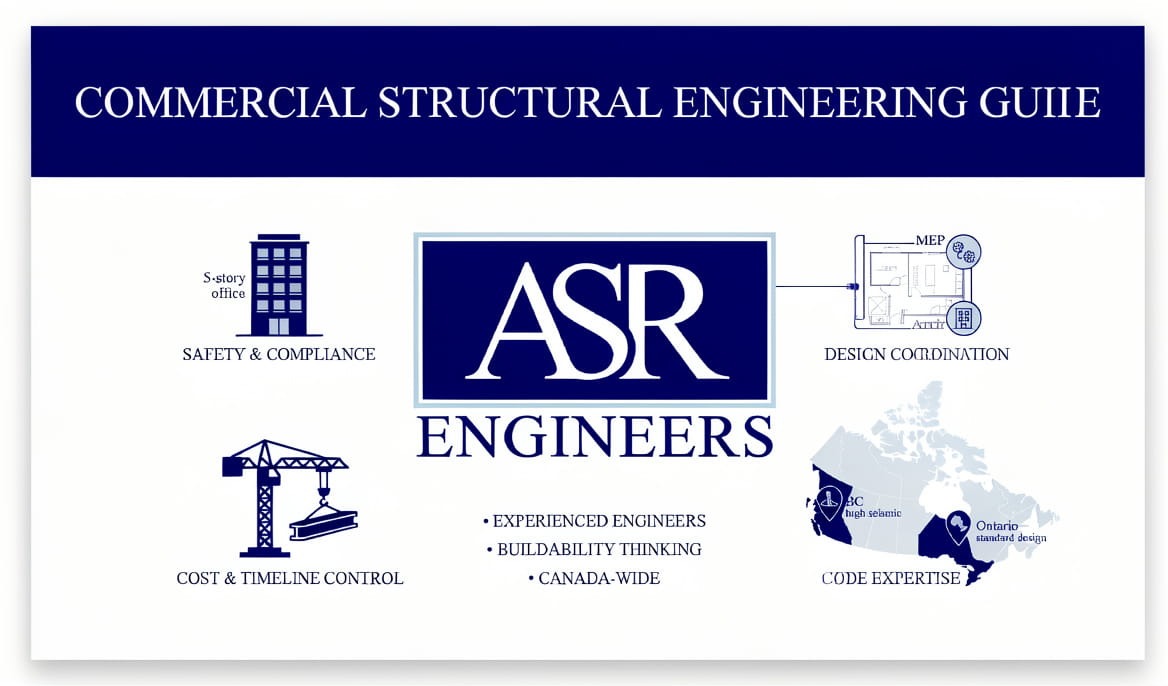
Provinces adopt the NBC but add amendments reflecting regional conditions. These amendments are not minor, they can significantly increase structural demand. Ontario emphasizes design coordination. British Columbia focuses on seismic resilience. Alberta prioritizes wind resistance. Quebec uses a distinct code language entirely.
Understanding your specific provincial code before design starts is critical.
Ontario Building Code | Coordination and Documentation
Ontario adopts the NBC with specific amendments. The real challenge in Ontario isn’t the load calculations, it’s the emphasis on explicit coordination between structural, MEP, and architectural disciplines.
Building officials expect clear documentation proving that HVAC ducts fit in beam depths, electrical conduits don’t pass through load-bearing walls, and plumbing doesn’t conflict with structural members.
Projects fail in Ontario not because they’re structurally unsound, but because coordination cannot be verified. Ontario requires careful documentation of how all building systems fit together. This coordination demand means structural design must involve architects and MEP engineers from the beginning, not after plans are finalized.
Snow load in Ontario ranges from 1.5 to 2.5 kPa depending on region. Seismic Design Category is SDC 1 (low risk) Ontario doesn’t have significant earthquake hazard. Wind design speed is 90 to 110 km/h.
British Columbia Building Code | Seismic and Energy
British Columbia has the highest seismic hazard in Canada due to the Pacific subduction zone. The BC Building Code adopts the NBC but adds major seismic amendments that often dominate structural decisions. In coastal BC, Seismic Design Category reaches SDC 3 or SDC 4 the highest in the country.
This means BC structural engineers don’t just design for gravity loads. They design for movement and lateral forces that can rival or exceed vertical loads. Seismic design can add 15 to 30 percent to structural cost in coastal areas.
The structural system must be ductile—capable of deforming safely during earthquakes, rather than simply strong.
BC also has strict energy code requirements. Snow loads range from 2.0 to 4.5 kPa (higher in mountains). Wind design speed is 100 to 130 km/h. The combination of seismic, snow, and wind often makes BC the most demanding province for structural design.
Alberta Building Code, Environmental and Wind Focus
Alberta faces lower snow loads in the south (0.9 to 2.0 kPa) but HIGHER wind loads on prairie sites with no natural wind breaks. The prairie environment means early design assumptions about wind speed are critical. If assumptions underestimate wind exposure, structural bracing designed early becomes inadequate.
Seismic Design Category in Alberta is SDC 1 to SDC 2 (low to moderate risk). The dominant design driver is wind load, typically 95 to 120 km/h design wind speed depending on location and exposure. Soil conditions also vary dramatically across Alberta, bearing capacity investigation is essential before foundation design.
Alberta projects fail when early environmental assumptions don’t match real site conditions discovered during geotechnical investigation. Geotechnical surprise (poor soil discovered during excavation) forces foundation redesign.
Quebec and Atlantic Canada Variations
Quebec uses distinct terminology aligned with its own standards rather than NBC language directly. This means designs must follow Quebec-specific interpretation and code reference standards. Atlantic provinces emphasize coastal wind resistance, with design wind speeds of 110 to 140 km/h in exposed areas. Hurricane-force wind design applies in some coastal zones.
How Do Building Codes Actually Shape Your Project’s Design Timeline and Approval Process?
Code requirements determine what your engineer designs, how long design takes, and whether permits approve on first submission. Understanding these impacts helps realistic project planning.
How Code Requirements Change Structural Design
Higher load requirements mean larger beams, stronger columns, more reinforcing steel. Snow load of 3.5 kPa requires heavier roof structure than 1.5 kPa. Seismic Category SDC 3 requires ductile connections designed for lateral movement. Fire-rating requirement of 4 hours might demand base isolation systems.
Consider two identical office buildings: one in Toronto, one in Vancouver. Toronto (SDC 1, standard loads) allows efficient, cost-effective design. Vancouver (SDC 3, high seismic) requires lateral load resistance, more steel, heavier connections, specialized detailing. Same building footprint. Different structural systems. Different materials. Different costs.
The building official focuses on verifying that your design satisfies the code adopted in your jurisdiction. If you design to NBC without provincial amendments, permits will be rejected or require modification.
How Codes Affect Permit Approval Timeline
Clear code language speeds approval. Standard office live load of 2.4 kPa is explicit in NBC, no questions asked. Innovative seismic design strategies require peer review (adds 4 to 8 weeks). Unusual materials like mass timber trigger code official consultation (adds 2 to 4 weeks). Ambiguous design documentation generates Requests for Information (RFIs), each cycle adding 2 to 4 weeks.
Building officials unfamiliar with new code editions take longer for review. An experienced official with NBC 2020 knowledge approves faster than one still learning the edition.
What Documentation Proves Code Compliance
Your structural engineer must provide calculations showing all load combinations, safety factors, and design methodology. Drawings must clearly label code requirements and material specifications.
Geotechnical investigation proves foundation assumptions correct. The professional engineer stamps plans and takes legal responsibility for compliance.
Building officials verify that design inputs match site conditions and that material specifications meet code. During construction, structural observation by the engineer confirms that actual construction matches design intent.
When Is Seismic Design Required, and What Does It Involve?
Seismic Design Categories assigned by the NBC determine whether earthquake-resistant design is required. SDC 1 locations need minimal seismic measures. SDC 2 requires ductile moment frames or shear walls.
SDC 3 demands capacity design and energy dissipation. SDC 4 (Vancouver area, critical facilities) may require base isolation.
Seismic design cost scales with category. SDC 2 adds 5 to 10 percent to structural cost. SDC 3 adds 15 to 25 percent. SDC 4 adds 25 to 50 percent or more.
In British Columbia, seismic design isn’t optional, it’s the dominant design driver. Structures must resist lateral forces from earthquakes. Design strategy prioritizes ductility and energy dissipation over pure strength. This creates fundamentally different structural systems than designs in low-seismic zones.
What Fire-Resistance Ratings Are Required by Your Building Code?
Fire-Resistance Rating (FRR) is the minimum time a structure must resist fire without collapsing. Required FRR depends on building height and occupancy type. A 10-story office requires 2-hour FRR. A 25-story office needs 3 to 4 hours. Warehouses typically need 1 to 2 hours.
How you achieve FRR matters structurally. Concrete naturally provides 1 to 2-hour ratings without additional cost. Steel requires fireproofing spray-applied coatings, encasement, or intumescent paint adding 30 to 50 dollars per meter of beam. Mass timber achieves ratings through char rate calculations.
Final Thoughts
Building codes determine safety, design strategy, material choices, and approval timeline. The NBC provides the national baseline. Provincial amendments reflect regional conditions. Getting codes right from the start prevents redesigns, permit delays, and compliance failures.
At ASR Engineers, we verify code requirements before design begins, design to your specific provincial standards, and navigate building officials smoothly. Whether your project is in Ontario, BC, Alberta, Quebec, or Atlantic Canada, we understand the regional requirements that affect your project.
Ready to ensure your project meets all code requirements? Schedule a code consultation with our engineers today.