The construction industry faces a persistent misconception: sustainable building materials drain project budgets. This belief has prevented countless engineers and contractors from exploring eco-friendly alternatives that could actually lower their total project expenses.
According to the Deloitte US report on sustainable construction, costs of sustainable and low-carbon materials will gradually decline compared to conventional materials due to lower ingredient costs of recycled or by-product materials.
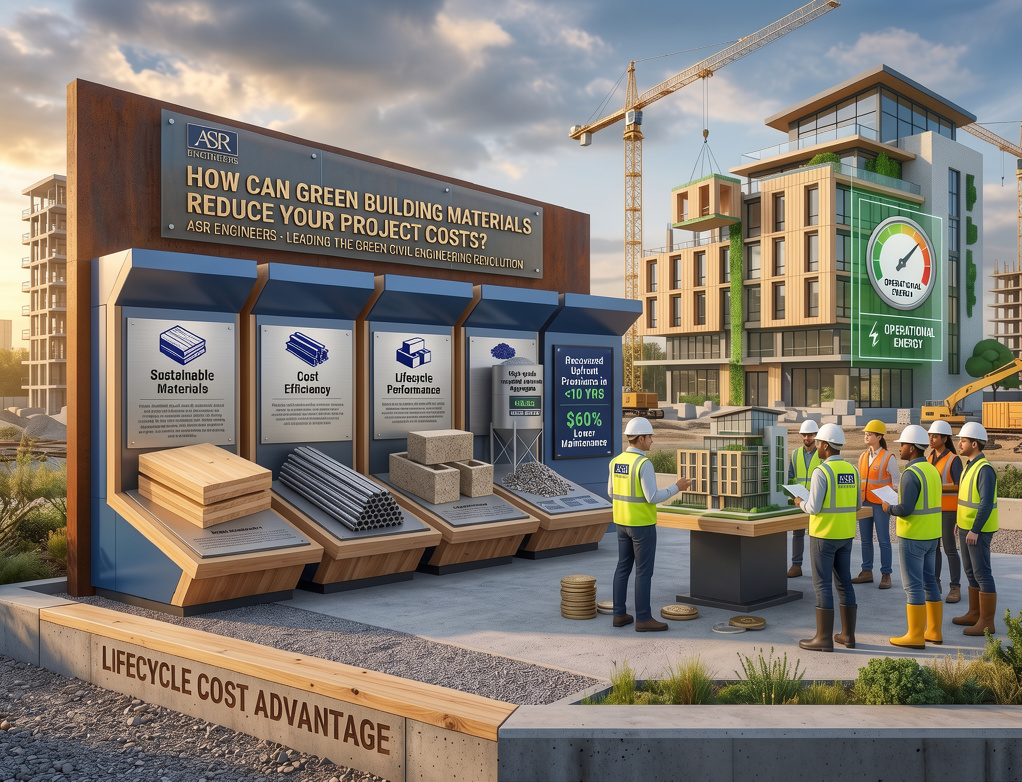
The reality is far different. While green materials may carry a higher upfront price tag, they deliver substantial savings through a mechanism most projects overlook: the lifecycle cost model.
What Does Lifecycle Cost Mean in Sustainable Construction?
When engineers evaluate building materials, they typically focus on immediate procurement costs. This narrow view misses the complete financial picture.
Lifecycle cost encompasses three critical phases: initial investment, ongoing maintenance, and operational expenses across the entire building lifespan, typically 30 to 50 years for most civil engineering projects.
A study published in the American Journal of Civil Engineering and Architecture reveals that sustainable construction methods save money by reducing a building’s carbon output and running costs. The journal demonstrates through comparative analysis that buildings using sustainable materials achieve significantly lower total costs of ownership despite higher initial investments.
Consider how this works in practice. A traditional concrete foundation might cost less to install but requires periodic repairs, sealant reapplication, and eventual replacement. A sustainable alternative like Ferrock, made from 95% recycled industrial waste—absorbs CO2 as it hardens, eliminating the maintenance burden altogether. Over 40 years, the sustainable option delivers superior financial performance.
Which Green Materials Deliver the Greatest Cost Reductions?
Sustainable building materials vary widely in their cost-saving potential. Understanding each option’s specific advantages helps engineers match materials to project priorities.
Recycled Steel: Strength Without Resource Extraction
Recycled steel performs identically to virgin steel in structural applications. According to research from Build Steel, recycled steel saves 75% of energy compared to virgin steel manufacturing.
This energy efficiency translates directly into cost reductions during the production phase. More importantly, recycled steel requires fewer protective coatings throughout its service life, lowering maintenance expenditures by approximately 30% over typical building lifespans.
Cross-Laminated Timber: Accelerating Construction Economics
Cross-laminated timber (CLT) represents engineered wood that rivals concrete and steel in load-bearing capacity. The primary cost advantage emerges from construction acceleration. Prefabricated CLT components reduce on-site labor time by 40–50% compared to traditional steel-frame construction. This time compression directly lowers overhead costs, equipment rental fees, and worker wages associated with extended project timelines.
Hempcrete: Energy Performance as Cost Driver
Hempcrete delivers exceptional thermal insulation properties, providing three times the thermal resistance of conventional insulation materials. Buildings incorporating hempcrete require substantially less energy for heating and cooling throughout their operational lives. This energy efficiency compounds over decades, creating cumulative savings that exceed the material’s initial cost premium within 5–7 years.
Recycled Concrete Aggregates: Waste Reduction Economics
Using recycled concrete aggregates instead of virgin quarried materials reduces raw material extraction. According to research published in Sustainable Cementitious Materials for Civil and Transportation Engineering, materials like low-clinker cement can reduce costs by 15–25% while simultaneously cutting CO2 emissions by 20–40%.
How Do Green Materials Actually Reduce Project Expenses?
The cost-reduction mechanisms in sustainable construction operate through multiple pathways. Understanding these channels helps contractors and engineers identify where savings will accumulate.
Lower Operational Costs Through Energy Efficiency
Green building materials with superior insulation properties directly reduce heating, cooling, and lighting expenses. Buildings constructed with sustainable materials consume 30–50% less energy for environmental conditioning. Over a 30-year operational period, this energy reduction represents hundreds of thousands in cumulative savings for commercial projects.
Reduced Maintenance and Repair Requirements
Durable sustainable materials withstand environmental stress with minimal intervention. Self-healing concrete, for example, automatically repairs microscopic cracks before they expand into structural problems. This self-repair capability eliminates costly maintenance cycles, extending the interval between inspections and reducing total maintenance budgets by approximately 60%.
Traditional materials require periodic reinforcement, protective coatings, and structural repairs. Sustainable alternatives eliminate these recurring expenses through superior material properties and inherent durability.
Accelerated Construction Schedules
Prefabricated sustainable materials like CLT and modular components reduce on-site construction time. Faster project completion means lower labor costs, reduced equipment rental periods, and decreased site overhead. Additionally, compressed timelines allow projects to move forward faster, enabling earlier revenue generation for commercial developments.
Waste Reduction and Material Efficiency
Sustainable materials derived from recycled sources reduce demand for virgin material extraction and processing. This substitution lowers material procurement costs. Additionally, precision manufacturing of sustainable materials creates less on-site waste, eliminating disposal fees and reducing the environmental burden associated with landfill management.
Market Value Premium and Incentive Access
Buildings utilizing green materials and achieving sustainability certifications command significantly higher property values. Research shows green-certified buildings maintain values approximately 4–8% higher than comparable conventional properties. This value premium often covers the cost of sustainable material investments within 5–10 years.
Government incentive programs and tax credits for sustainable construction further offset material costs. Many jurisdictions provide financial incentives for projects meeting LEED, BREEAM, or equivalent sustainability standards, effectively reducing the net cost of green material adoption.
What Should Your Implementation Strategy Include?
Successfully capturing cost reductions from green materials requires structured planning throughout the project lifecycle.
The foundation begins with lifecycle cost analysis. Rather than comparing upfront material prices, engineers should evaluate total cost of ownership by modeling three decades of operational expenses alongside initial investment. This analysis reveals which materials deliver superior lifetime financial performance for specific applications.
Cost estimation becomes more sophisticated when considering green materials. Construction cost estimator software should model multiple scenarios: traditional materials versus sustainable alternatives, locally-sourced materials versus imported options, and prefabricated versus site-built approaches. Each scenario reveals different cost profiles and timeline implications.
Supply chain optimization plays a critical role. Sourcing materials from local suppliers reduces transportation costs and carbon footprint simultaneously. Building relationships with suppliers of recycled and sustainable materials creates opportunities for bulk purchasing discounts and reliable delivery schedules.
Understanding regulatory requirements prevents costly design modifications. Building codes increasingly favor sustainable materials. Early engagement with code officials ensures that material selections achieve compliance without requiring expensive redesigns during construction.
Why Do Industry Leaders Increasingly Adopt Green Materials?
Real-world projects demonstrate that sustainable materials deliver on their cost-reduction promise. The Edge Building in Amsterdam stands as perhaps the world’s most sustainable office structure.
This facility integrates energy-efficient materials and smart building systems throughout its design. The result: 30–40% lower operational costs compared to conventionally constructed office buildings, with the construction cost premium recovered within 6–8 years through operational savings.
Mjøstårnet Tower in Norway showcases the financial viability of mass timber construction. Using cross-laminated timber extensively, the 18-story building achieved 30% faster construction timelines and 20% lower operating costs. Property values command 25–30% premiums above comparable conventional buildings, demonstrating how green material selection enhances market value.
These projects exemplify a fundamental truth: green materials represent not environmental idealism but sound financial engineering. The cost benefits emerge through multiple channels: reduced operational expenses, lower maintenance requirements, accelerated construction schedules, and enhanced property values.
Moving Forward With Sustainable Material Selection
The transition toward green building materials requires overcoming perceptions about upfront costs while recognizing the substantial lifecycle cost advantages. Engineers and contractors positioned to embrace this transition gain competitive advantages through lower total project costs, faster execution timelines, and enhanced property values.
The question is no longer whether green materials cost more, it’s whether your projects can afford to ignore their cost-reducing potential.
Life cycle assessment methodologies exist to quantify these savings. Construction cost estimator tools enable scenario modeling. Real-world precedents demonstrate measurable financial success.
Sustainable construction represents rational economics applied to building. When ASR Engineers evaluate material selections for your next project, the cost-reduction pathways inherent in green materials deserve serious consideration alongside environmental benefits.
Final Thoughts
The shift toward green building materials represents far more than environmental activism, it’s a pragmatic response to the economics of modern construction. Every project faces resource constraints, timeline pressures, and budget limitations.
Green materials address these challenges by delivering superior long-term financial performance while simultaneously reducing environmental impact.
The data is clear, the precedents are established, and the tools for implementation are available. The transition isn’t about choosing sustainability over economics; it’s about recognizing that sustainable materials embody superior economics.
Your competitive advantage in civil engineering increasingly depends on understanding and leveraging these cost-reduction mechanisms. The question is no longer whether your projects can afford green materials, it’s whether they can afford to ignore them.