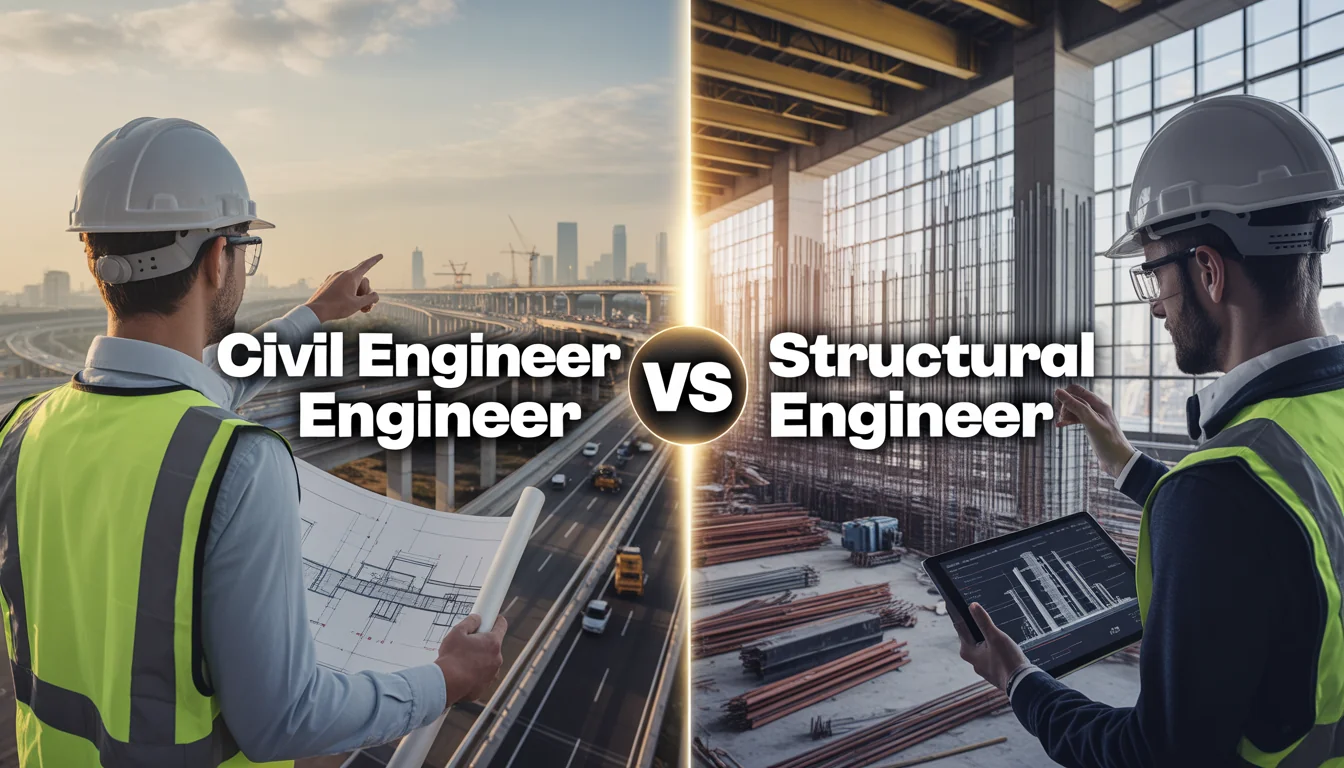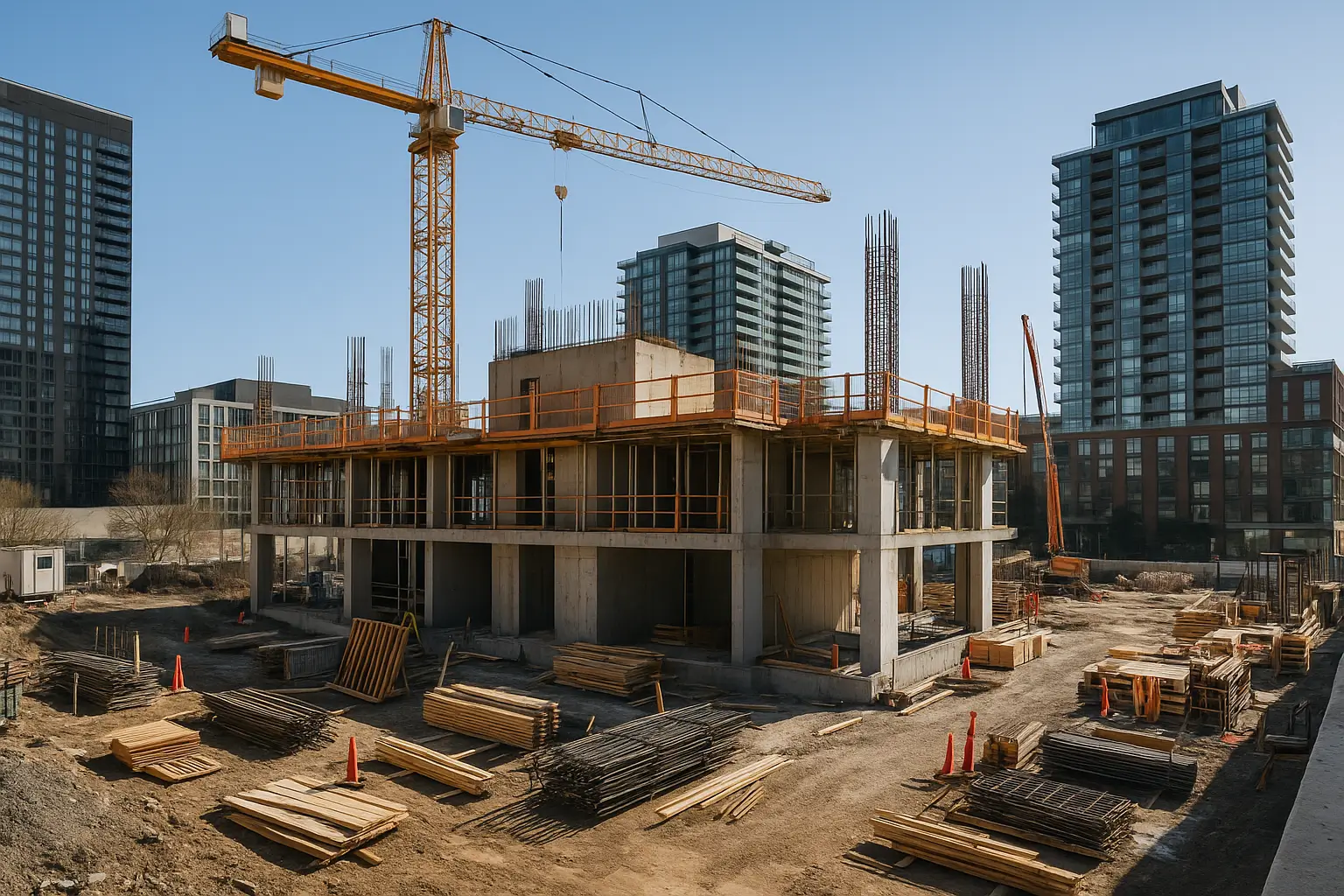
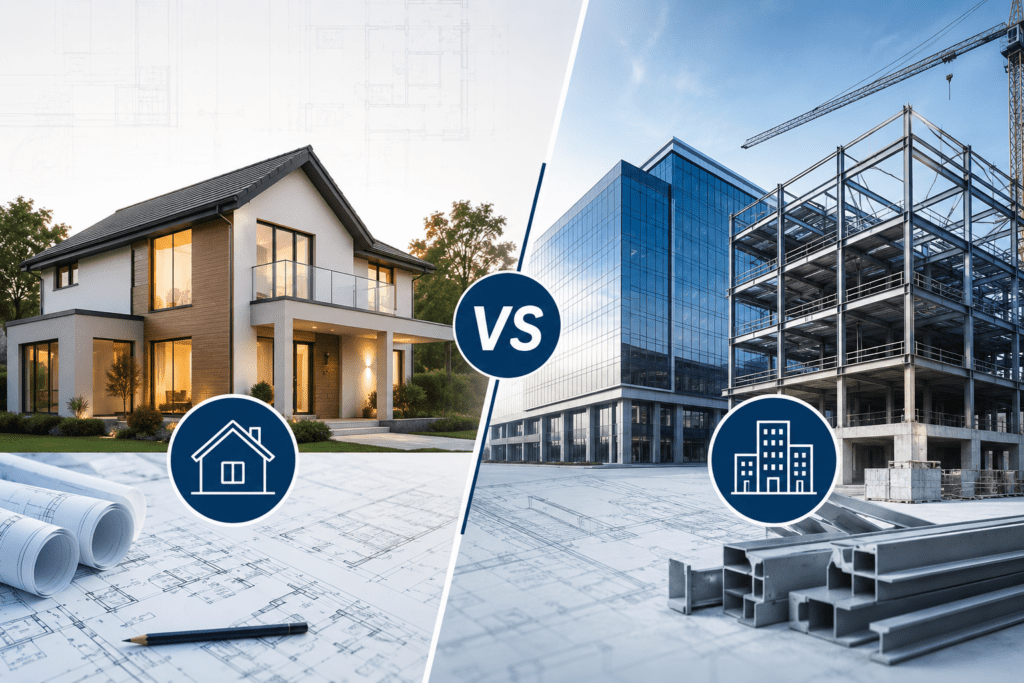
Structural engineering shapes every building’s safety and durability. Yet residential and commercial projects demand dramatically different approaches. Understanding these differences helps architects, engineers, and developers make smarter decisions from the blueprint stage.
This guide breaks down the key differences between residential and commercial structural engineering covering design complexity, regulatory requirements, materials, and the expertise each demands.
How Do Residential and Commercial Structures Differ Fundamentally?
Residential and commercial buildings serve entirely different purposes, creating distinct structural challenges.
Residential structures include single-family homes, townhouses, duplexes, and apartment complexes. Most residential buildings span 2-3 stories with straightforward load paths. Design prioritizes affordability and simplicity.
Commercial structures include office buildings, warehouses, retail spaces, and healthcare facilities. These buildings are typically multi-story, larger in scale, and support heavier loads. Design prioritizes durability, flexibility, and public safety.
The fundamental difference: residential design focuses on cost-effective solutions for predictable household usage. Commercial design must handle diverse occupancies, heavy equipment, and strict safety regulations.
What Load Challenges Make Residential Design Different?
Load analysis determines structural capacity. Residential and commercial buildings face very different loading scenarios.
Residential live loads (occupants, furniture, equipment) are modest and predictable:
- Bedrooms: 2-3 kN/m²
- Living areas: 3-4 kN/m²
- Kitchens: 4-5 kN/m²
Dead loads (building weight) come from wood studs, concrete foundations, drywall, and roofing. These weights follow predictable patterns, simplifying calculations.
Environmental loads are calculated using simplified methods:
- Wind loads: Basic wind tables
- Snow loads: Simplified provisions
- Seismic forces: Prescriptive design requirements
Residential engineers often use standard load tables and simplified analysis methods. Complex residential projects homes on sloping sites with basement spans require more detailed analysis, but these remain exceptions.
What Load Challenges Make Commercial Design Complex?
Commercial buildings face substantially higher and more variable loads than residential structures.
Commercial live loads vary dramatically by building type and function:
- Office buildings must support numerous occupants, furniture, and office equipment
- Retail spaces accommodate constant customer traffic and heavy merchandise
- Industrial and manufacturing areas handle machinery and specialized equipment
- Parking structures support continuous vehicle loads and traffic patterns
Dead loads increase with material choice. Commercial structures use steel, concrete, and composite systems, all heavier than residential timber framing.
Environmental loads demand advanced analysis:
- Wind loads: Detailed pressure calculations accounting for building height
- Seismic forces: Response spectrum analysis for earthquake safety
- Snow accumulation: Complex calculations for various roof geometries
Commercial engineers use 3D finite element modeling and advanced computational analysis. This complexity justifies higher design fees and extended timelines.
What Materials Define Each Building Type?
Material selection fundamentally shapes structural design.
Residential materials emphasize cost-effectiveness:
- Wood framing (2×4 studs, engineered trusses)
- Concrete foundations
- Shear walls for lateral stability
- Shallow foundations (spread footings, slab-on-grade)
Timber remains dominant because it’s affordable, familiar to contractors, and adequate for typical residential loads. Standard connections and details accelerate design and construction.
Commercial materials prioritize performance and durability:
- Structural steel: Enables long spans (8-15+ meters), flexible layouts, and high load capacity
- Reinforced concrete: Excellent fire resistance, accommodates complex geometry, allows post-tensioning
- Composite systems: Steel-concrete combinations optimize performance while controlling deflection
Commercial projects often employ sophisticated systems like post-tensioned slabs, transfer beams, and transfer slabs—structures absent in residential work.
How Do Building Codes Shape Each Building Type?
Building codes establish minimum safety requirements. Residential and commercial codes differ significantly.
Residential Building Codes (IRC)
The International Residential Code governs residential construction:
- Permits prescriptive design paths (no detailed analysis required)
- Allows simple projects to bypass extensive calculations
- References ASCE 7 standards for wind and seismic loads
- Focuses on basic safety for household occupancy
Simple residential structures can follow code tables without engineering analysis. This streamlines design and reduces costs.
Commercial Building Codes (IBC)
The International Building Code governs commercial construction:
- Mandates detailed structural analysis
- References multiple design standards (ASCE 7, AISC 360, ACI 318)
- Requires comprehensive documentation
- Enforces strict fire-resistance ratings (typically 2-4 hours)
- Demands ADA accessibility compliance
- Calculates occupancy limits and emergency egress routes
Commercial engineers must master multiple standards and ensure strict regulatory compliance.
What Unique Challenges Face Residential Projects?
Residential projects present practical challenges despite lower complexity.
Complex Site Conditions
Steeply sloping sites require innovative solutions. Engineers might design concrete basement walls spanning horizontally to perpendicular shear walls—creative solutions beyond standard approaches. Soil bearing capacity variations affect foundation depth and cost. Geotechnical investigation determines whether shallow or deep foundations are necessary.
Architectural Constraints
Modern open-concept living eliminates load-bearing walls. Structural engineers must introduce beams and columns where homeowners prefer open spaces. This tension between aesthetics and structural necessity requires careful design.
Cost Pressures
Homeowners prioritize affordability. Structural engineers must optimize designs—using standard components, economical methods, and value engineering, while maintaining safety. The balance between cost and structural adequacy drives residential design decisions.
What Unique Challenges Face Commercial Projects?
Commercial projects involve greater complexity and higher stakes.
Large Open Spaces and Flexible Layouts
Retail environments require column-free floor plans. Long-span beams, post-tensioned concrete slabs, and composite systems achieve this. Office buildings need flexible layouts to accommodate various tenants. Structural systems must allow future modifications.
Multi-Use Building Complexity
Mixed-use developments combine retail, office, and residential functions. Different sections have different loading requirements. Transfer beams and transfer slabs shift loads between structural grids. Upper floors with heavy equipment require different structural capacity than lower floors.
Mechanical System Integration
Commercial buildings integrate complex mechanical, electrical, plumbing, and fire protection systems. HVAC ductwork, electrical conduits, plumbing lines, and sprinkler systems must coordinate with structural design. Modern projects use Building Information Modeling (BIM) to manage this complexity.
Professional Liability and Risk
Commercial building failures affect hundreds or thousands of occupants. Professional liability exposure is substantially higher. Structural engineers manage this risk through rigorous quality assurance, peer review of complex systems, and comprehensive documentation.
How Do Design Processes Compare?
Residential and commercial design timelines and methodologies differ significantly.
Residential Design Process
Timeline: 2-4 weeks typical
- Site assessment and geotechnical investigation
- Code research and initial design
- Load calculations using standard tables
- Member sizing and connection detail selection
- Plan documentation
- Building permit submission
Simple residential projects follow straightforward paths. Designers reference standard details and proven solutions. Design iterations remain minimal.
Commercial Design Process
Timeline: 6-12 weeks typical (complex projects may require more time)
- Comprehensive site assessment and detailed geotechnical study
- Thorough code compliance review across multiple standards
- 3D finite element modeling of structural systems
- Multiple load case combinations and deflection analysis
- Vibration analysis if needed
- Peer review of complex systems
- Extensive coordination with architects and MEP engineers
- BIM coordination of all building systems
- Comprehensive design documentation
Commercial design involves multiple iterations, advanced analysis, and coordination with various disciplines. Complexity justifies extended timelines and higher design costs.
Which Structural Engineer Should You Hire?
Selecting the right structural engineer matters significantly.
Residential Structural Engineers
Specialize in:
- Light-frame wood construction
- Simple concrete systems
- Basic foundation design
- IRC code compliance
- Cost-effective solutions
Experience requirements depend on project complexity. Simple residential projects may use junior engineers. Complex projects with challenging site conditions require senior engineers with specialized expertise.
Commercial Structural Engineers
Specialize in:
- Structural steel and reinforced concrete systems
- Advanced structural analysis and design
- IBC code compliance
- Complex multi-story structures
- Multi-discipline coordination
Commercial projects demand experienced engineers. Standard commercial work requires senior-level engineers. High-rise or specialized buildings demand principal engineers with deep expertise.
Key Takeaway: Match Project Complexity with Engineer Expertise
Residential and commercial structural engineering are distinct specializations. Each demands different knowledge, tools, and professional approaches.
Residential engineers solve practical problems within simplified codes, prioritizing affordability. Commercial engineers navigate sophisticated structural systems and strict regulations, prioritizing durability and public safety.
For project success, match your building type with appropriately experienced structural engineers. Choose a residential specialist for homes and small-scale projects. Select commercial experts for offices, retail, and multi-story structures.
Structural engineering excellence comes from specialized expertise and thorough understanding of building-specific challenges. Your project deserves the right expert team.
Final Thoughts
The distinction between residential and commercial structural engineering reflects different philosophies and professional responsibilities. Residential engineers prioritize affordable, practical solutions while commercial engineers manage complex systems protecting hundreds of occupants.
Selecting the right structural engineer whose expertise matches your project complexity ensures safety, code compliance, and long-term durability. Both specializations demand continuous professional development as building codes evolve and construction technology advances. Your structural engineering investment determines your building’s success for decades to come.
FAQs
Choose a residential structural engineer for homes, renovations, and small-scale projects. For offices, retail spaces, warehouses, or multi-story developments, hire a commercial structural engineer with experience in complex building systems.